
A research team led by Profs. LI Jing and LIU Qinhuo from the Aerospace Information Research Institute of the Chinese Academy of Sciences (AIRCAS) has developed the world's first global, high-resolution map of leaf chlorophyll content (LCC), providing a new method for closely tracking plant health and ecosystem productivity worldwide.
The study was recently published in Scientific Data.
Utilizing data from the European Space Agency's Sentinel-2 satellites, the team built a dataset named MuSyQ Global LCC. With a spatial resolution of ten meters, the map is finer than existing global chlorophyll products, which typically have resolutions ranging from 300 to 500 meters.
Chlorophyll is the pigment that enables plants to absorb sunlight and conduct photosynthesis. The chlorophyll content in leaves reflects plant health and their efficiency in absorbing carbon from the atmosphere. However, the absence of high-resolution, global-scale data has hindered efforts to understand how chlorophyll varies across different ecosystems and how it responds to environmental changes.
To fill this knowledge gap, the research team applied the Chlorophyll Sensitive Index (CSI) to the cloud-based Google Earth Engine (GEE) platform. This approach allowed the team to process large volumes of Sentinel-2 data and generate a global chlorophyll map with an unprecedented spatial resolution.
In addition to the global dataset, the researchers developed a dedicated web application that allows users to create customized chlorophyll maps. Users can select specific regions, time periods, and resolutions, as well as generate time-series profiles to study vegetation changes over time.
A 100-meter resolution version of the data is freely available via the Science Data Bank, along with a dedicated web application on the GEE platform. Validation results indicate that the new product is highly consistent with the existing global MODIS LCC product, while offering higher accuracy and far finer details.
By enabling the observation of plant health at a global scale with near-field resolution, the MuSyQ Global LCC dataset is expected to support research and decision-making in fields such as precision agriculture, forestry monitoring, and the assessment of climate change impacts on vegetation.
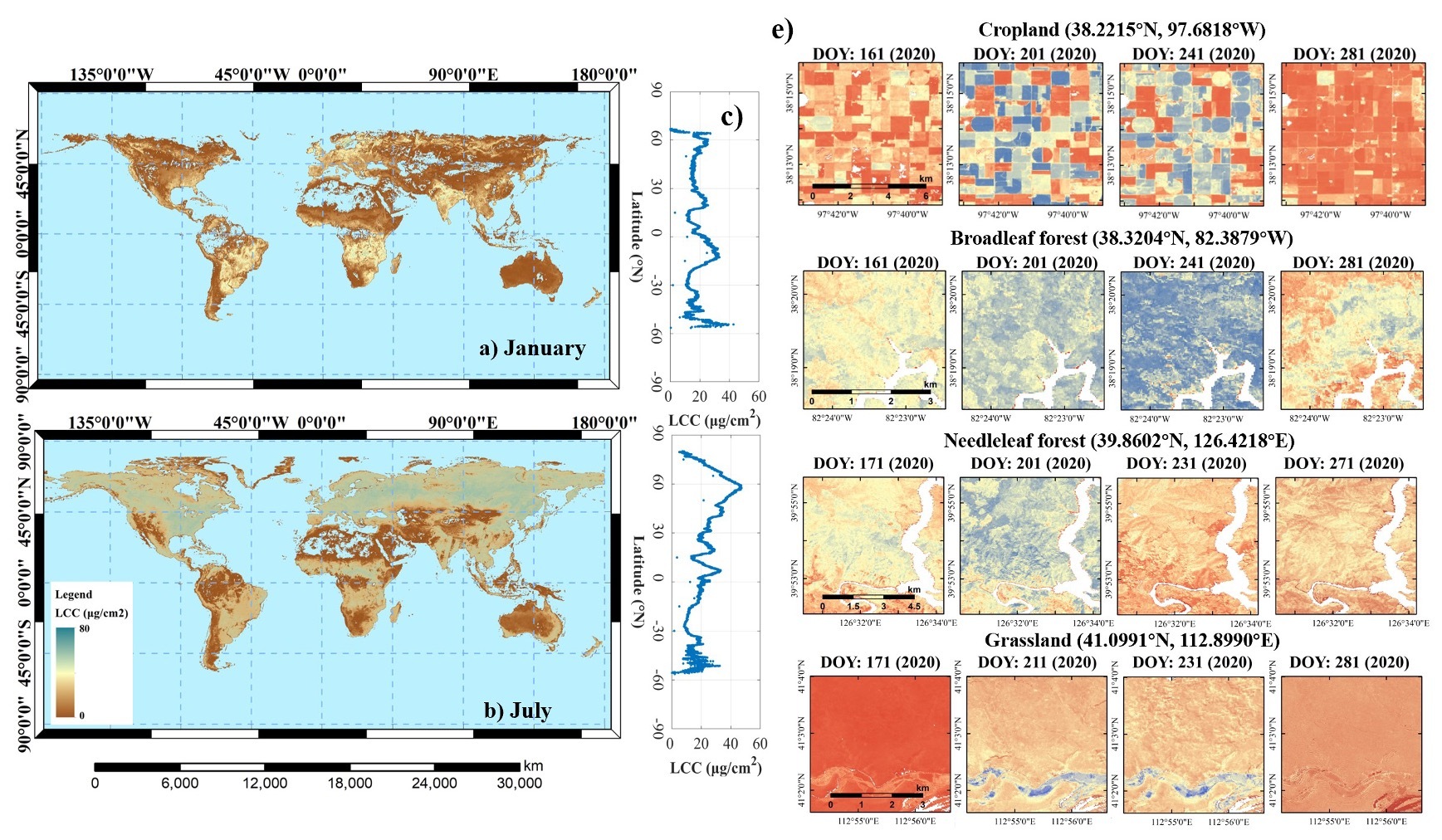
Global distribution of the MuSyQ Global LCC product. Mean LCC in January 2020 (a) and July 2020 (b). Latitudinal averages of chlorophyll (c,d). Seasonal variations at representative sites for different vegetation types in 2020 (e). (Image by AIRCAS)
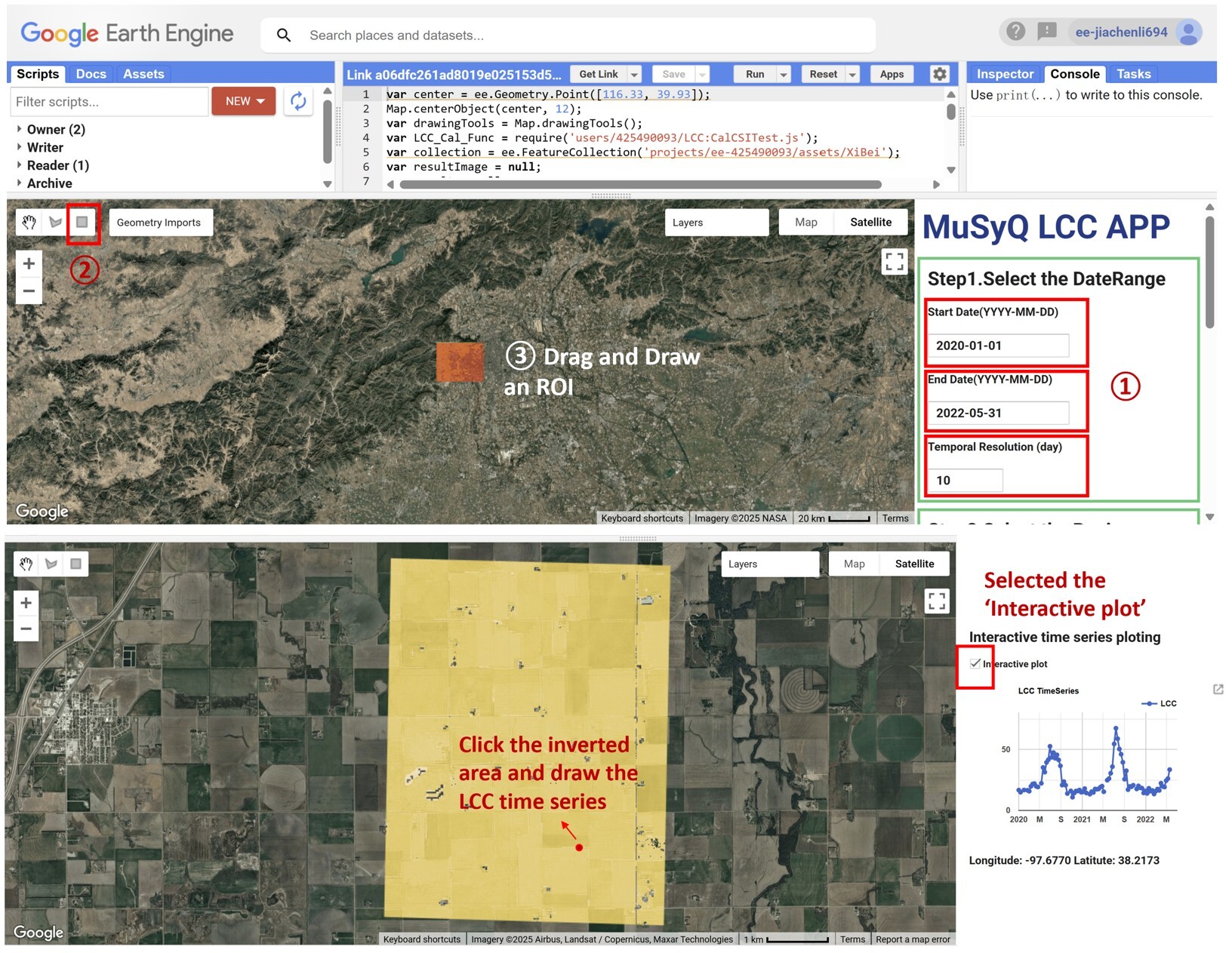
Generating the customized chlorophyll product and the temporal profile using the web application. (Image by AIRCAS)

86-10-68597521 (day)
86-10-68597289 (night)

52 Sanlihe Rd., Xicheng District,
Beijing, China (100864)
Copyright © 2002 - Chinese Academy of Sciences


